

Why your in-house marketing team costs more than you think
Salary is only the start. Here is how to add up the full cost of an in-house marketing team, line by line, using your own numbers.

In-house marketing team costs are almost always higher than the salary line on your budget. Once you add payroll taxes, benefits, software, training, equipment, your own management time and the cost of replacing people who leave, the true figure can look very different. The only reliable way to know is to add it up yourself with your own numbers.
This guide is for owners and managers of small and mid-size businesses who either have one or two marketing people on staff, or are thinking about hiring. It does not tell you what anyone should earn. Wages vary widely by city, role and experience. Instead, it gives you a worksheet so you can calculate the real cost and compare it fairly with other options.
"I hired someone and I'm still doing the marketing"
This is one of the most common frustrations we hear. An owner hires a marketing coordinator, expecting marketing to be "handled." Six months later the owner is still writing captions at night, approving every flyer, and wondering why sales have not moved.
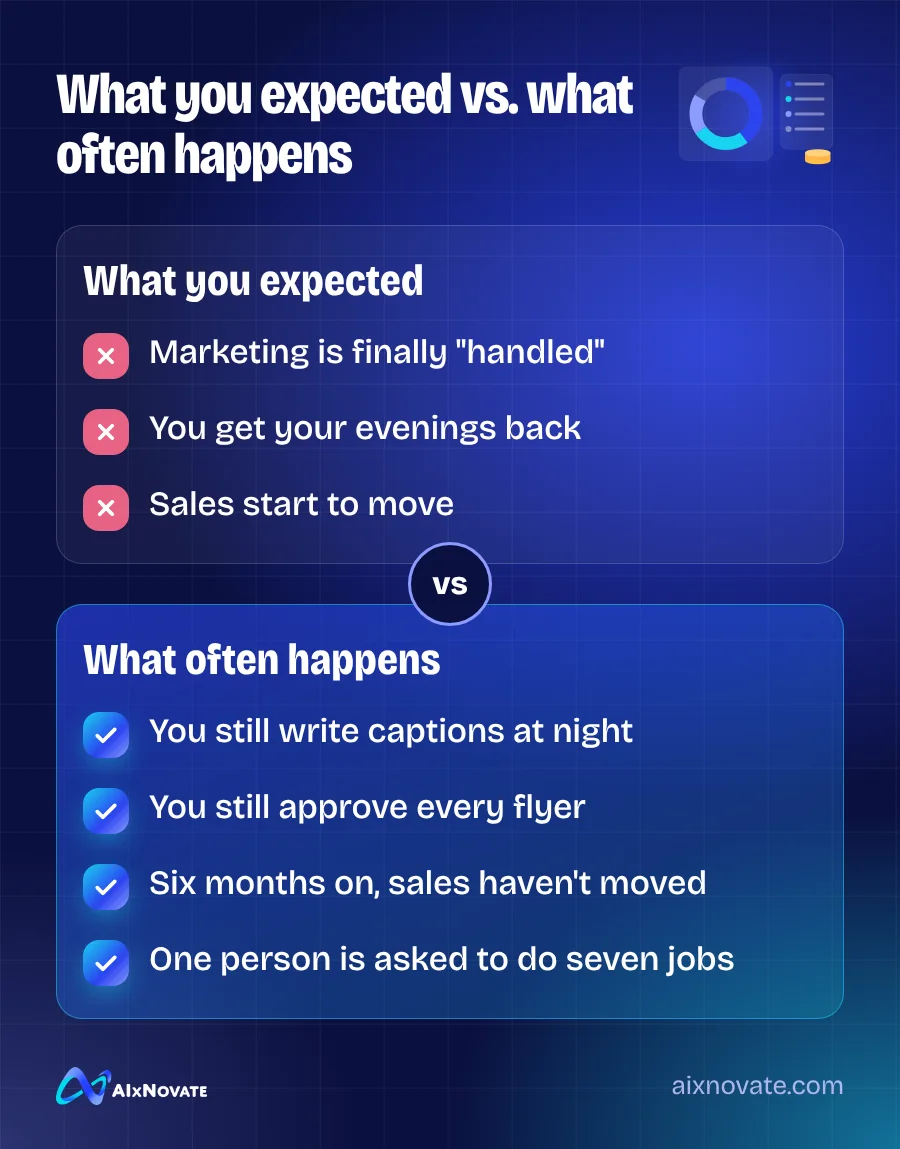
Usually nobody did anything wrong. One person was asked to be a strategist, designer, copywriter, photographer, ad manager, web editor and data analyst at once. No single hire is strong at all of those. The gaps get filled by the owner, by extra tools, or not at all, and each of those has a cost.
The in-house marketing team costs most owners miss
Use this table as a checklist. Fill in the right column with your own annual figures.
| Cost component | Where to find your number |
|---|---|
| Wages or salary | Offer letter or payroll report |
| Employer payroll taxes and workers' comp | Your payroll provider or accountant |
| Health insurance and other benefits | Benefits invoices, divided per employee |
| Paid time off and holidays | Days off times daily wage cost |
| Software and subscriptions | Card statements: design, scheduling, email, AI, stock photos |
| Equipment | Computer, phone, camera, lighting, spread over their useful life |
| Training and courses | Certifications, workshops, conference fees |
| Your management time | Your weekly hours on marketing times the value of your hour |
| Recruiting and turnover | Job ads, interview hours, ramp-up time when someone leaves |
| Outside help anyway | Freelancers for video, web fixes, translation, printing |
For general guidance on employer responsibilities such as payroll taxes and insurance, the SBA business guide is a good starting point. Your accountant can confirm the figures that apply to your business in California.
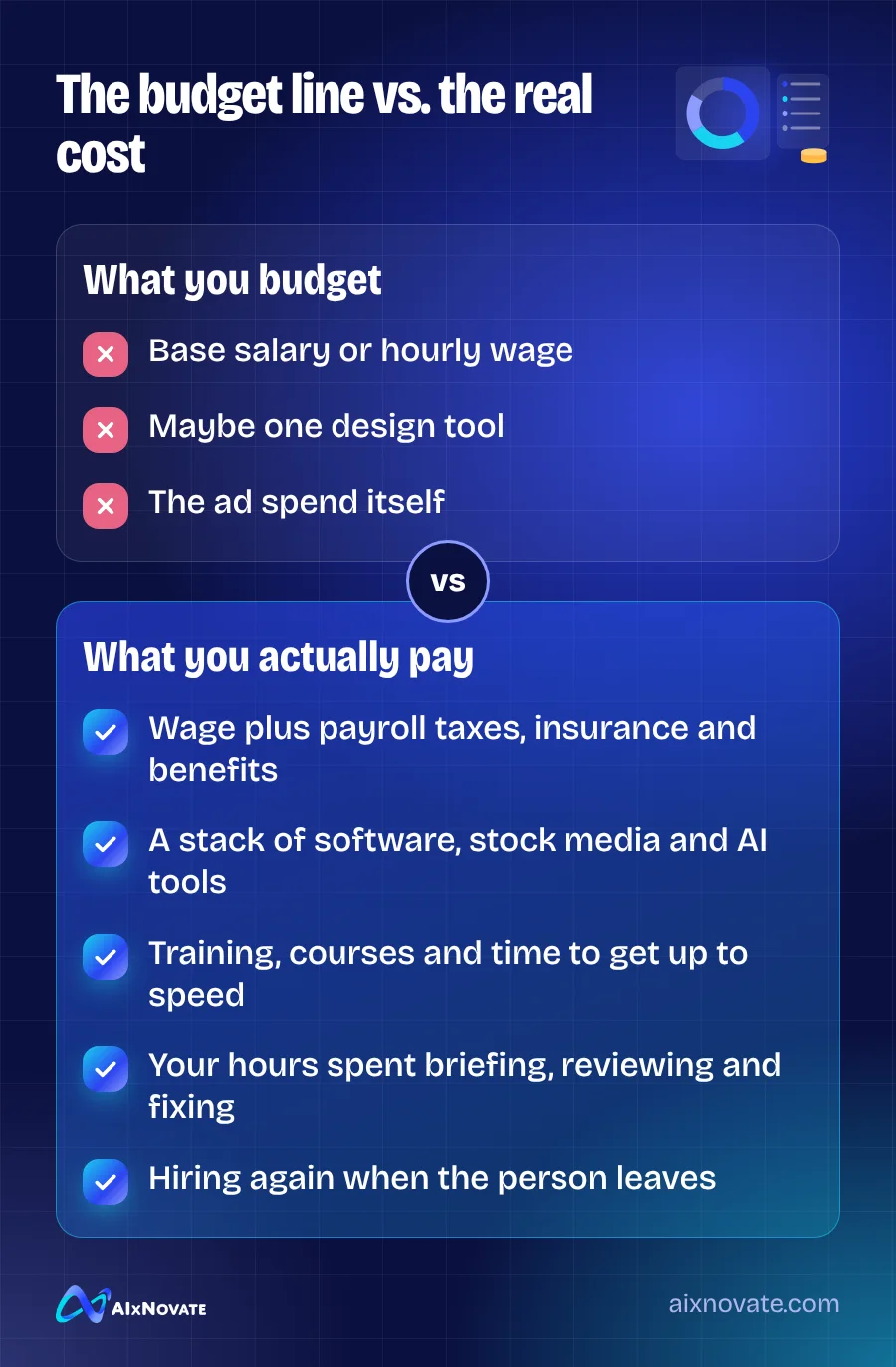
How to calculate your true cost in five steps
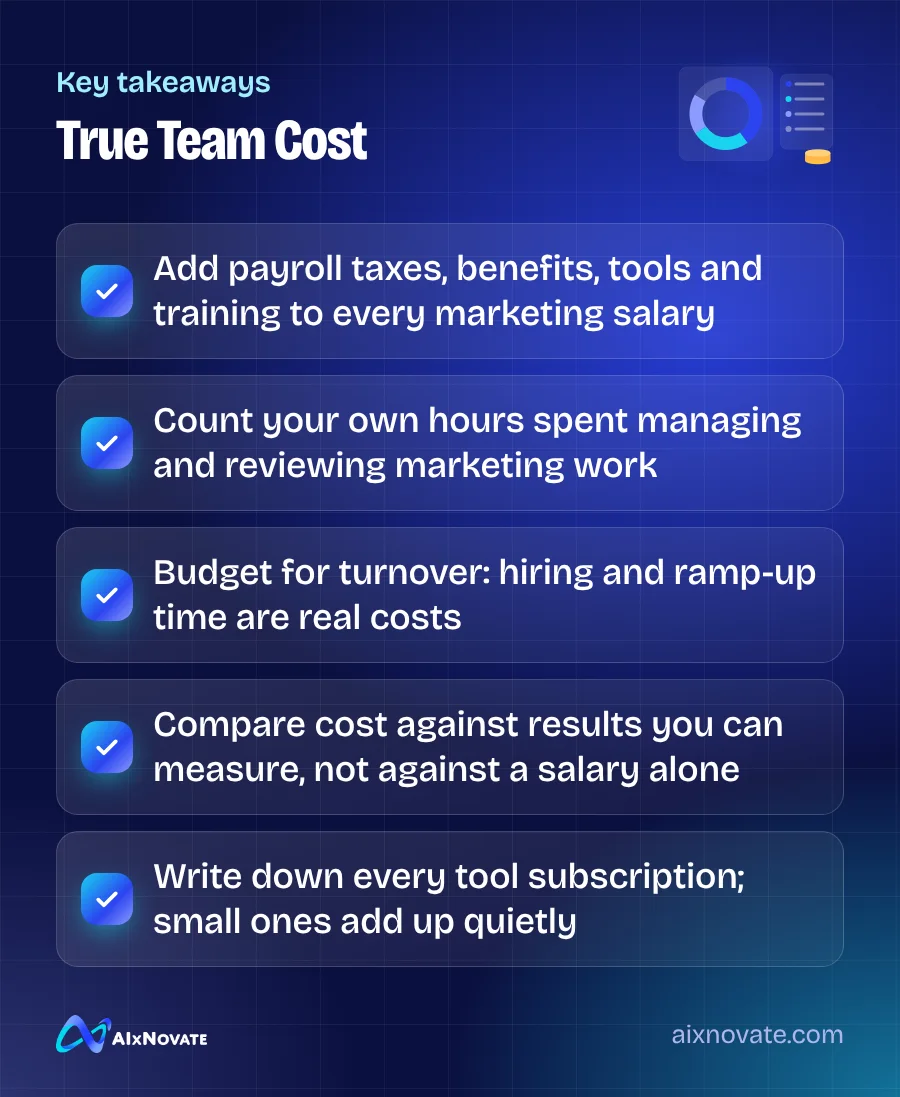
- Start with wages for one year. Use actual payroll, not the advertised range.
- Add employer costs. Payroll taxes, workers' comp, benefits and paid time off. Ask your payroll provider for the employer-side total.
- Add tools and equipment. List every marketing subscription. Many businesses find several they forgot about.
- Add your time. Track for two weeks how many hours you spend on marketing decisions, reviews and fixes. Multiply by a fair value for your hour. Owners skip this line most often, and it is often one of the biggest.
- Add turnover risk. If marketing roles in your business have turned over before, estimate the hiring cost plus the weeks of reduced output while a new person learns your brand.
Be honest with the estimates. It is tempting to round down your own hours or to leave out the freelancer you call every few months. The point of the worksheet is not to prove that hiring was a mistake; it is to see the real number so you can decide with clear eyes.
Divide the total by twelve to get a monthly figure. That is the number to compare with any alternative, whether it is a freelancer, an agency or a mix.
Cost is only half the question: what are you getting?
A high cost is fine if the output pays for itself. The problem is when nobody measures output. Write down what the team actually produced last quarter and what changed because of it:
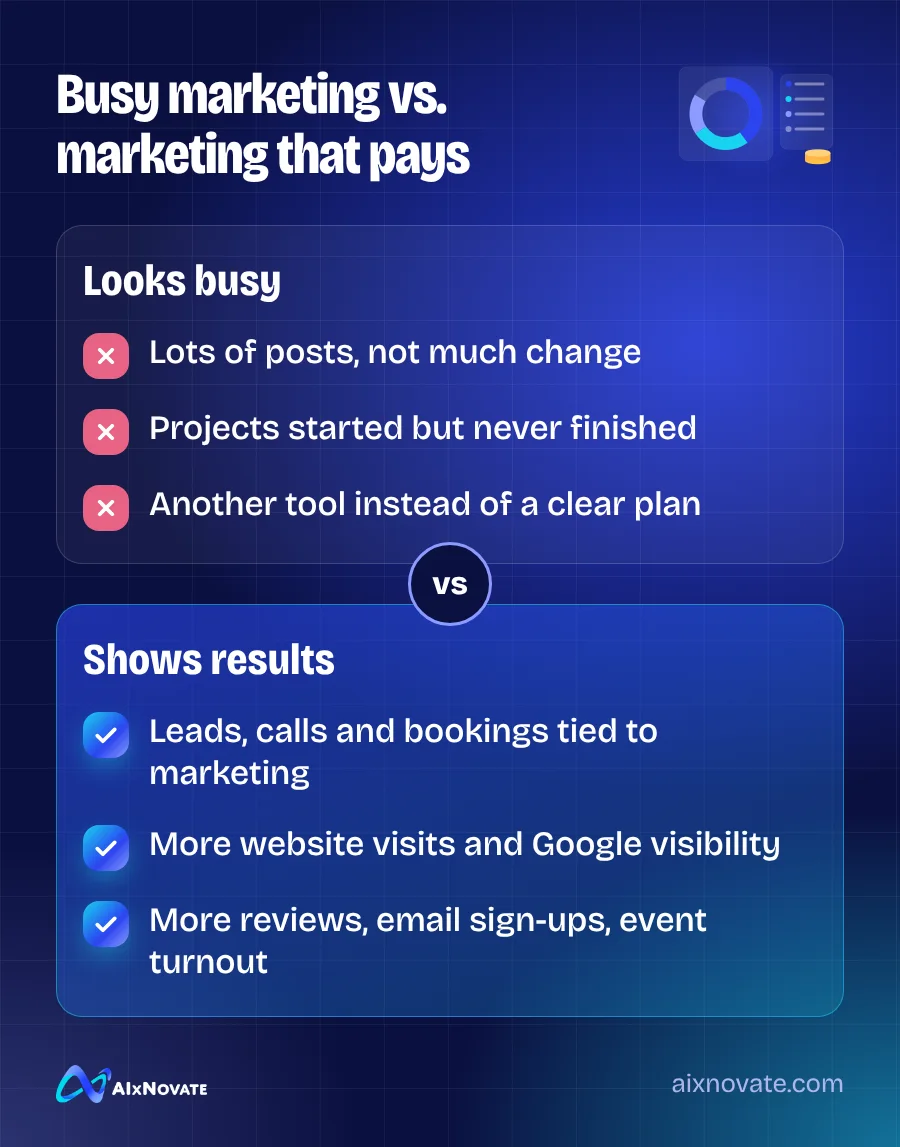
- Leads, calls, bookings or sales you can tie to marketing.
- Website traffic and search visibility, which you can track for free in Google Search Console.
- Reviews gained, email list growth, event turnout.
- Projects started but never finished.
If the answer is "lots of posts, not much change," the issue may be direction rather than effort. A simple plan, like the one in our guide to building a 2027 marketing plan you will follow, often helps an in-house person more than another tool subscription.
Orange County realities that affect the math
Several local factors push the hidden costs up for Orange County businesses:
- Multiple languages. Many businesses in Garden Grove, Westminster and Santa Ana need content in Vietnamese, Spanish, Korean or Chinese. One person rarely writes well in all of them, so translation and review become extra costs.
- A competitive hiring market. Skilled marketers in Southern California have options. Plan for the chance that a good hire leaves.
- California employment rules. Employer obligations here can be more involved than in some states. Get your accountant's view before you set a budget.
Ways to lower the cost without losing control
Hiring is not wrong, and for many businesses a dedicated person is the right call. A few options make the investment work harder:
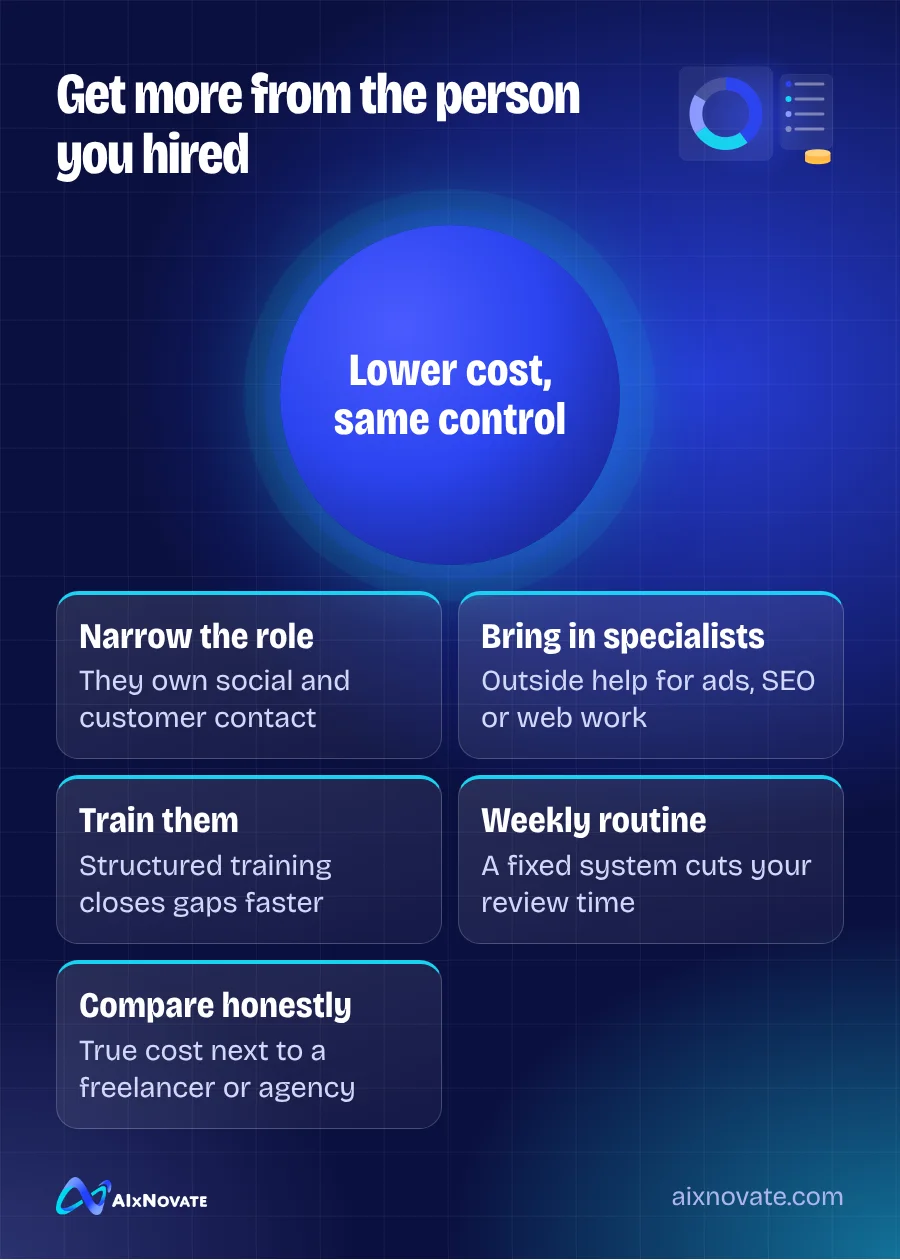
- Narrow the role. Let your staff member own what they do best, such as social content and customer communication, and get specialist help for ads, SEO or web work.
- Train the person you have. Structured marketing training for in-house staff can close skill gaps faster than trial and error.
- Use a weekly system. A fixed routine, like the two-hour-a-week marketing system, cuts owner review time.
- Compare honestly. Put your true cost next to a freelancer or agency quote using the method in our marketing employee vs. agency comparison.
Frequently asked questions
What is included in the true cost of a marketing employee?
The true cost includes wages plus employer payroll taxes, workers' compensation, benefits, paid time off, software subscriptions, equipment, training, recruiting, and the time you or a manager spend directing and reviewing the work. Add any freelancers you still hire for specialized tasks. Ask your payroll provider and accountant for exact employer-side figures for your business.
How do I put a value on my own time spent on marketing?
Track your marketing hours for two weeks, including approvals, meetings and late-night fixes. Then choose a fair hourly value, such as what you would pay a manager to cover your other duties, or what an hour of sales or service work earns the business. Multiply the two. The result is a real cost, even though no invoice shows it.
Is it cheaper to outsource marketing than to hire?
It depends on your workload, the skills you need and how much management time you can give. Outsourcing can cost less for specialized work you need occasionally, while a staff member may be better for daily content and customer contact. Calculate your full in-house cost first, then compare it against specific quotes for the same scope of work.
If you want help building the comparison for your business, you can book a free consultation with AIxNovate or browse our full list of marketing services to see which parts could be shared.