
AI marketing for small businesses in 2027: what actually works
An honest look at where AI saves small businesses real time in marketing, where it still fails, and how to plan your 2027 marketing around it.
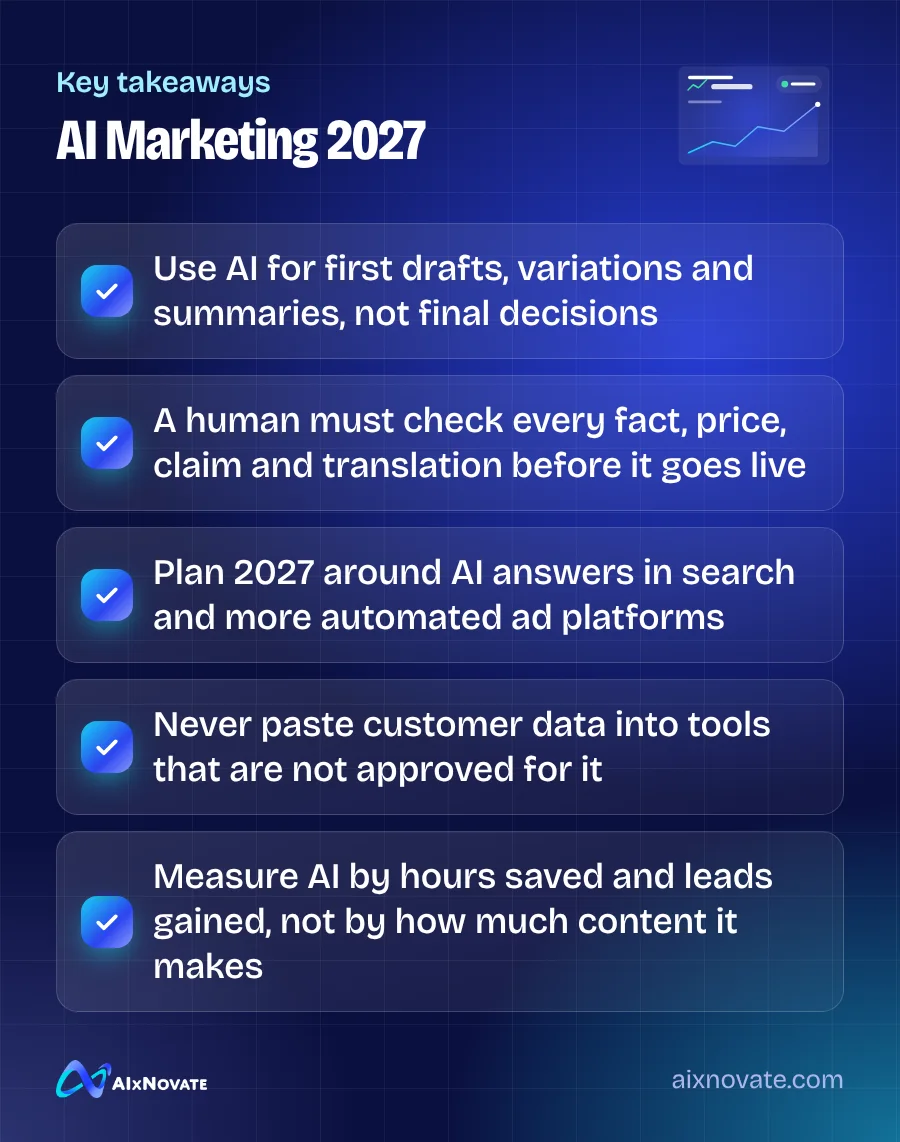
AI marketing for small businesses works best as a fast assistant, not a replacement for your judgment. In 2027 the practical wins are drafting content, producing ad and email variations, summarizing reviews and research, and handling routine questions, while a person still checks accuracy, brand voice and anything legal or sensitive.
This guide is for owners and managers of local businesses in Orange County and across the U.S. who keep hearing that AI will change marketing and want to know what is worth their time. It skips the hype and focuses on what you can set up this quarter, what to avoid, and how to plan the year ahead.
Where AI marketing for small businesses actually helps
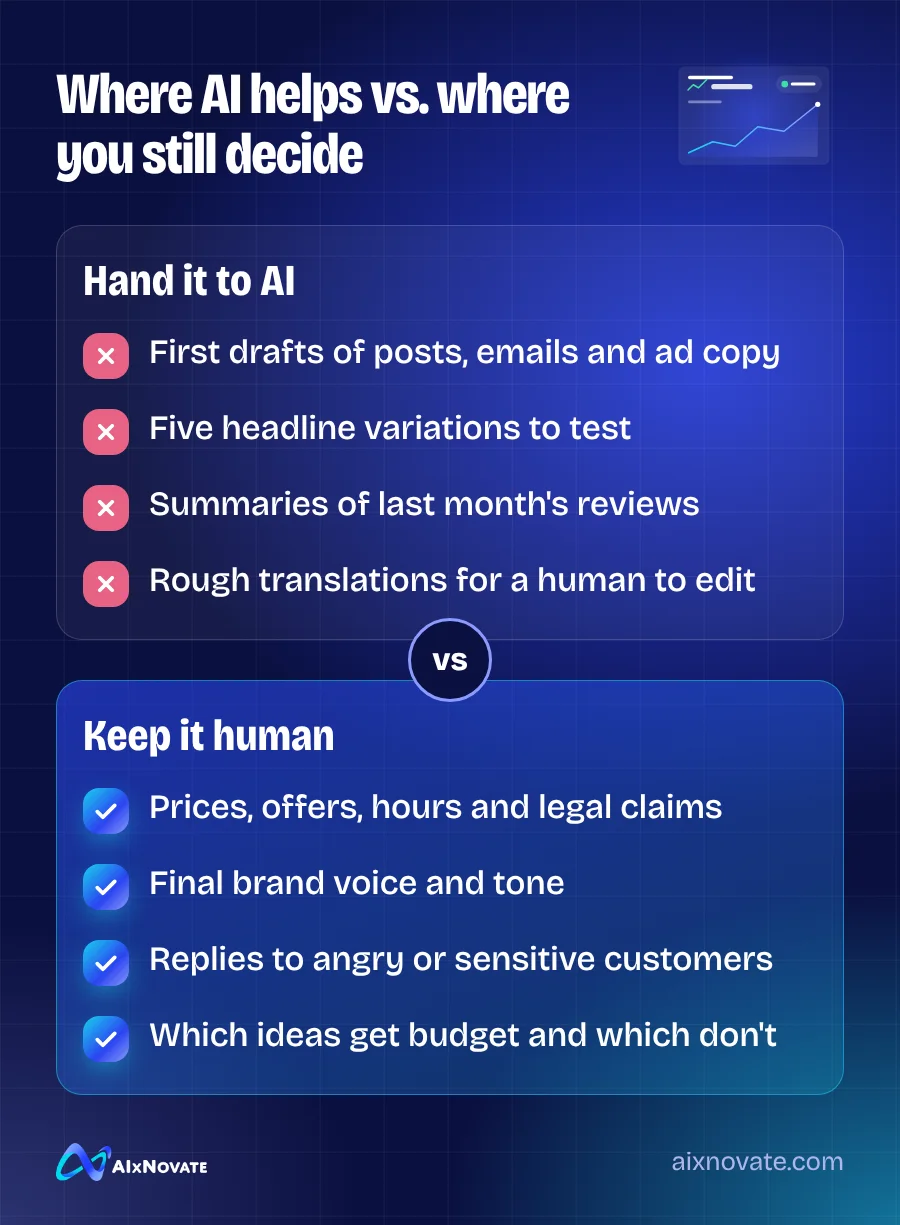
The most reliable gains come from tasks that are repetitive, text-heavy and easy for a human to check. If you can read the output in a minute and know whether it is right, AI is usually a good fit.
- First drafts. Social captions, email newsletters, blog outlines and service page drafts. You supply the facts and the angle; the tool gives you something to edit instead of a blank page.
- Variations. Five headlines for one ad, three versions of a promotion email, short and long versions of the same post. Testing becomes realistic when variations take minutes.
- Repurposing. Turning one customer FAQ answer into a post, a short video script and a Google Business Profile update.
- Summaries. Pasting in a batch of public reviews and asking for recurring praise and complaints, or summarizing a long vendor proposal.
- Research starting points. Listing questions customers might ask about a service, or angles competitors seem to use. Treat it as brainstorming, then verify.
If you want a broader overview of business uses beyond marketing, our earlier piece on how small businesses can benefit from AI solutions covers operations and customer service too.
Where AI still falls short
Being honest about the limits is what keeps AI from hurting your brand. These are the problems we see most often with small business owners who adopt it quickly.
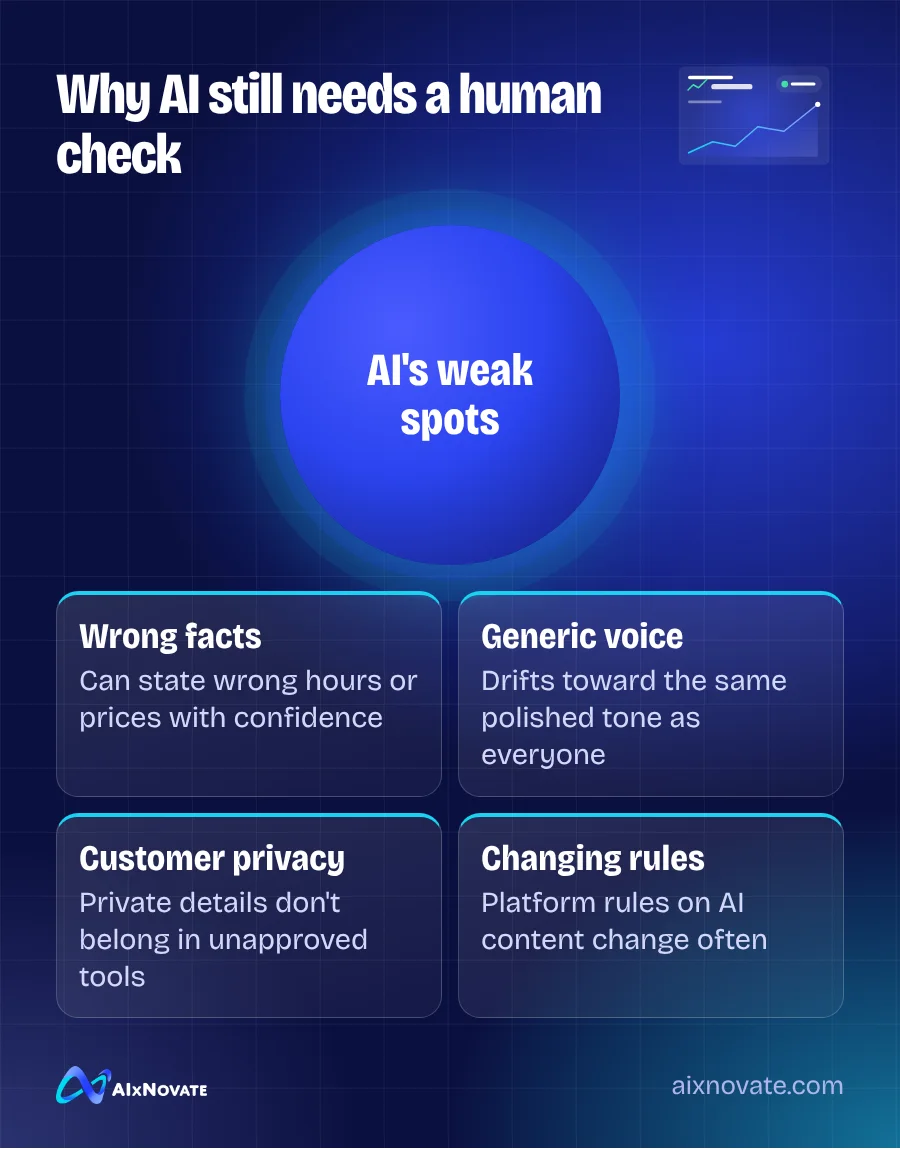
Accuracy
Language models can state wrong facts with total confidence. They invent opening hours, mix up services, misquote regulations and make up statistics. Anything with a price, a date, a medical or legal claim, or a promise to customers needs a human check every time.
Brand voice
Left alone, AI writing drifts toward the same polished, generic tone. Customers notice. A nail salon in Little Saigon and a law firm in Irvine should not sound identical, and our guide on using ChatGPT without sounding like a robot shows how to fix that with examples and editing rules.
Privacy and platform rules
Customer names, phone numbers, health details and payment information should not go into a tool unless you have confirmed how that tool stores and uses data. Ad platforms and search engines also have their own rules on AI content, which change often. Google, for example, explains that using generative AI is not against its guidelines by itself, but mass-producing pages without adding value is; read its guidance on using generative AI content on your website.
What to plan for in 2027
Nobody can forecast exact numbers for next year, and you should be skeptical of anyone who does. But several trends are already visible, and they are worth building into your 2027 plan.
- AI answers in search. Google shows AI Overviews for many queries, and customers also ask chat assistants for recommendations. Google says there are no special tricks to appear in its AI features beyond solid SEO fundamentals; see AI features and your website. Clear, accurate, well-structured pages matter more, not less.
- More automated ad platforms. Google and Meta keep pushing campaign types where the platform chooses placements and audiences. Your job shifts toward supplying good creative, clean conversion tracking and honest offers.
- More content noise. When everyone can publish more, real photos, real reviews, named staff and specific local detail become stronger trust signals.
- Customers asking first, clicking later. People may arrive having already read a summary of your business. Make sure what is out there about you is correct and consistent.
Our guide on getting recommended by ChatGPT and Google AI in 2027 goes deeper on the search side of this shift.
A simple AI workflow for a busy owner
You do not need ten tools. Most small teams do well with one general AI assistant, their existing design tool and a clear review routine.
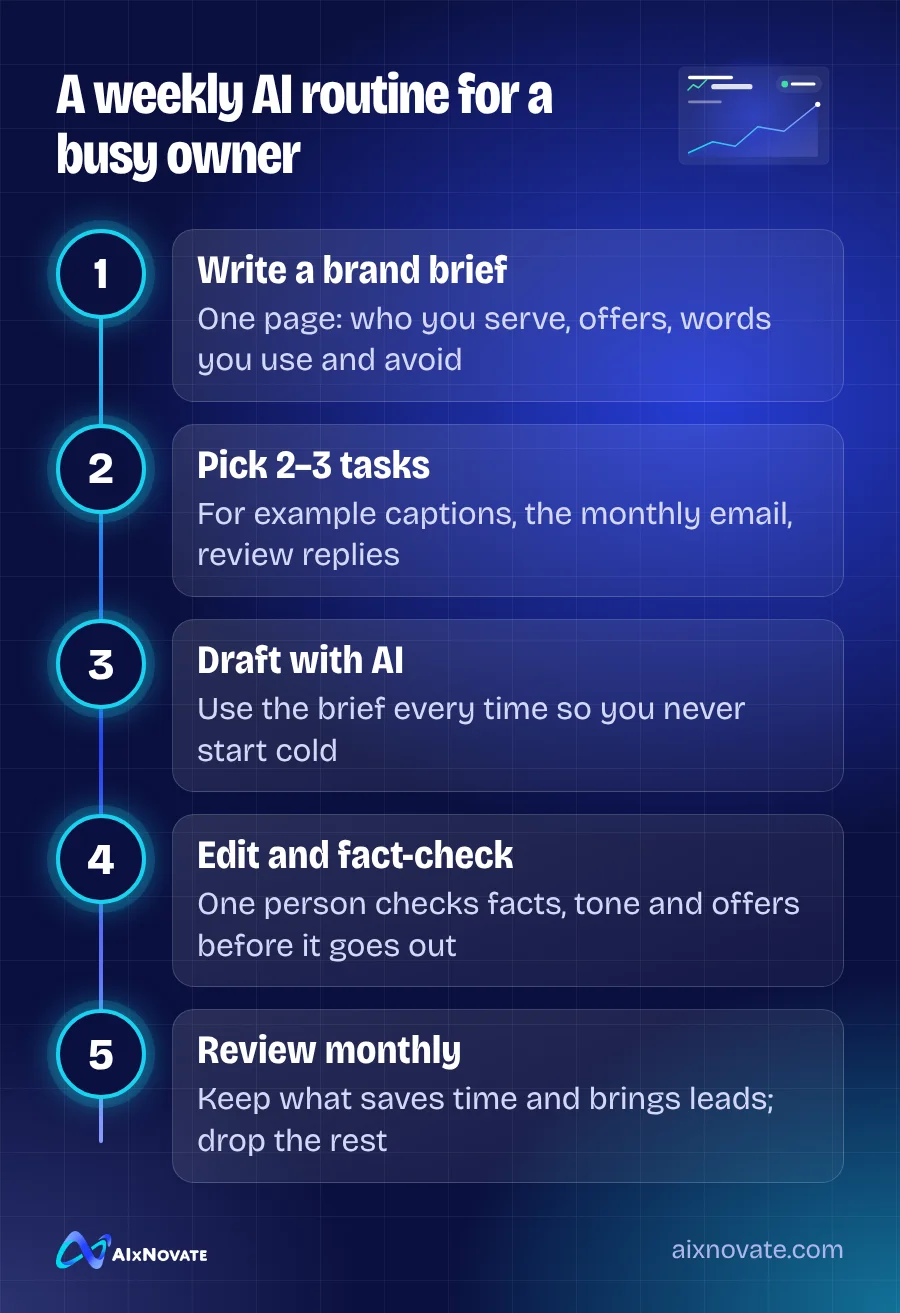
- Write a one-page brand brief. Who you serve, what you offer, prices you are willing to publish, words you use and words you never use, plus three examples of past posts you liked.
- Pick two or three repeatable tasks. For example: weekly social captions, monthly email, and review reply drafts.
- Draft with AI, using the brief every time. Paste the brief in or save it in the tool's instructions so you are not starting cold.
- Edit and fact-check. One person owns final approval. They check facts, tone, offers and anything that could be read as a promise.
- Review results monthly. Keep what saves time and brings leads; drop what does not.
Teams often get more out of this when everyone learns the same habits, which is the idea behind our marketing and AI training programs: shared prompts, shared review rules, fewer surprises.
Using AI in Garden Grove and Orange County
Orange County businesses often market in more than one language. In Garden Grove, the Census Bureau reports that 67.9% of residents age 5 and older speak a language other than English at home (2019–2023), according to U.S. Census QuickFacts. That makes AI translation tempting, and it can help with first drafts.
The catch is nuance. A Vietnamese post for older customers in Little Saigon, a Spanish promotion for families in Santa Ana and a Chinese menu description each need a fluent reviewer who knows how your customers actually talk. Use AI to save time on the draft, never as the final word on a language you cannot check yourself.
Local detail is also where AI is weakest. It does not know that your parking lot fills up during lunch on Brookhurst Street or that your regulars come in after church on Sundays. Add those details yourself; they are what make your content sound like you.
How to measure whether AI is working
The wrong measure is volume. Publishing three times as many posts means little if calls and bookings stay flat. Track a few simple numbers before and after you adopt a tool:
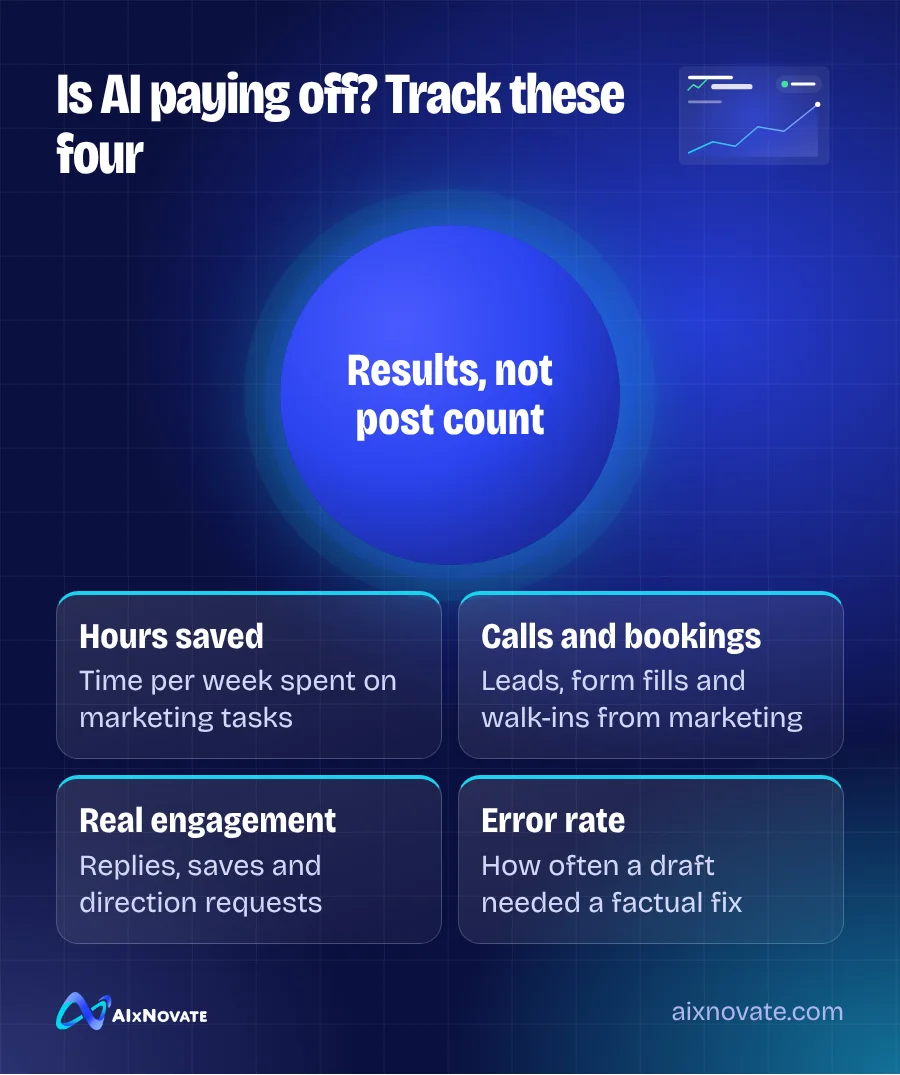
- Hours per week spent on marketing tasks.
- Calls, form fills, bookings or walk-ins you can attribute to marketing.
- Engagement quality: replies, saves, direction requests, not just likes.
- Error rate: how often a draft needed a factual correction.
If AI saves hours but errors keep slipping through, tighten your review step before scaling up. The common pitfalls are collected in 7 AI marketing mistakes small businesses make.
Frequently asked questions
Is AI marketing worth it for a very small business?
Usually yes, if you start small. One owner or manager using a general AI assistant for drafts, captions and review replies can save several hours a week without new costs beyond a subscription. The value disappears if nobody checks the output, so build a short review step into the routine from day one and judge results by leads, not post count.
Will Google penalize content written with AI?
Google has said that how content is produced matters less than whether it is helpful, original and accurate. AI-assisted pages that answer real customer questions can perform well. Mass-producing thin pages mainly to manipulate rankings can break its spam policies. Edit every AI draft, add your own expertise and local detail, and publish only what you would be comfortable showing a customer.
What should I never put into an AI tool?
Avoid customer personal information, health details, payment data, passwords, employee records and confidential contracts unless you have confirmed the tool's data handling and have permission to use that data. In California, privacy laws such as the CCPA can apply to how businesses handle personal information. When in doubt, remove names and identifying details before pasting anything in.
How do I prepare my marketing for 2027?
Get the basics right: accurate business listings, clear service pages, real reviews and reliable conversion tracking. Then pick a few AI-assisted tasks that save time and set a monthly review. These fundamentals hold up whether customers find you through classic search, AI answers or ads, which is the safest bet when the tools keep changing.
If you want a second opinion on where AI fits in your marketing, you can book a free 30-minute consultation, or see how we approach market research and strategic planning for local businesses.