
Bilingual marketing in Garden Grove: Vietnamese and English
How Garden Grove businesses can market in Vietnamese and English: where to use each language, how to translate well, and how to set up bilingual web pages.

Bilingual marketing in Garden Grove means presenting your business clearly in both Vietnamese and English, matched to where each audience looks: signs, Google, social media, your website and in-store materials. Done well, it helps you serve long-time Vietnamese-speaking customers and reach English-speaking newcomers without confusing either group.
This guide is for business owners in and around Little Saigon, and for any Garden Grove business that serves Vietnamese-speaking customers. Much of the advice also applies to Spanish, Korean or Chinese if those are your customers' languages.
Why bilingual marketing matters in Garden Grove
Garden Grove is one of the most multilingual cities in the country. According to U.S. Census QuickFacts, 67.9% of residents age 5 and older speak a language other than English at home (2019–2023), and 41.6% of residents identify as Asian alone. The city marked 50 years of Little Saigon business growth in 2025, as noted in the City of Garden Grove's Little Saigon 50 news.
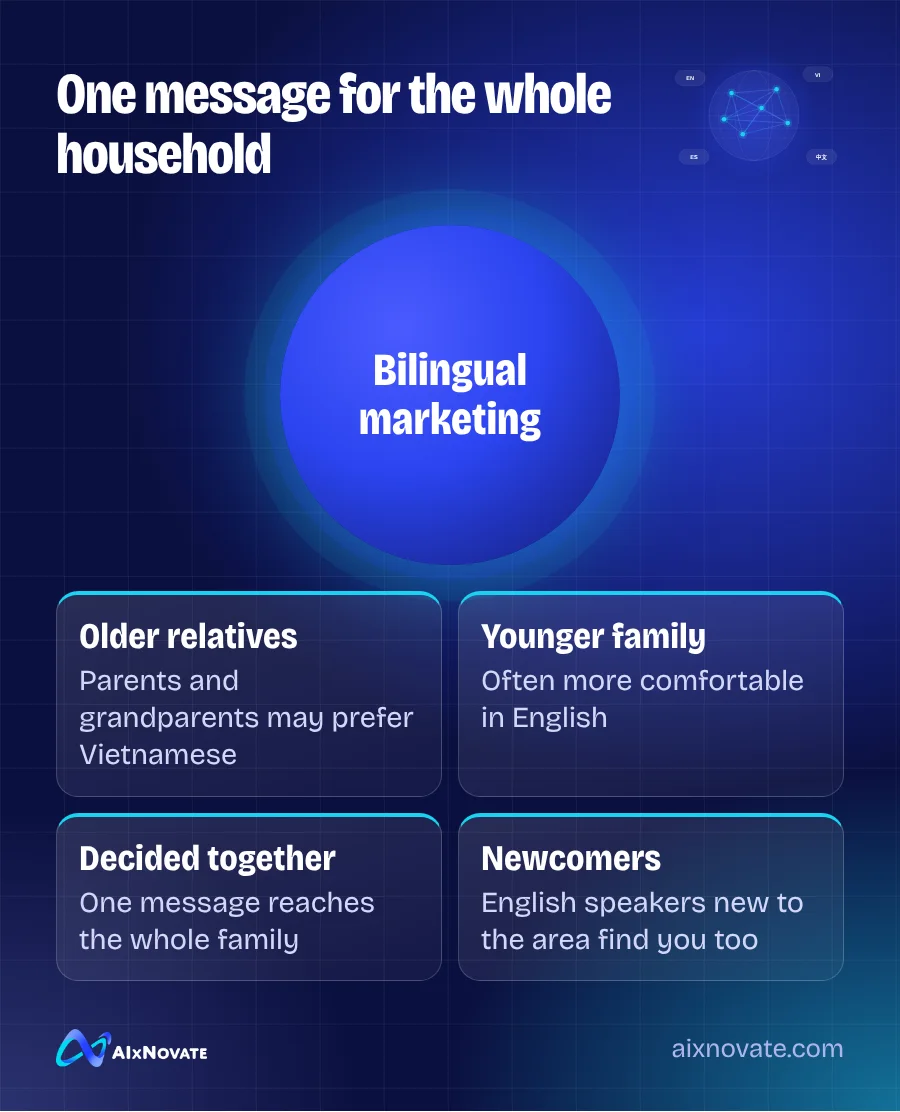
That does not mean every customer prefers Vietnamese. Many second- and third-generation customers are more comfortable in English, while their parents and grandparents may prefer Vietnamese. Families often decide together. Bilingual marketing lets one message reach the whole household.
Decide which language goes where
Not every channel needs both languages in equal measure. Start by mapping where each audience actually is.
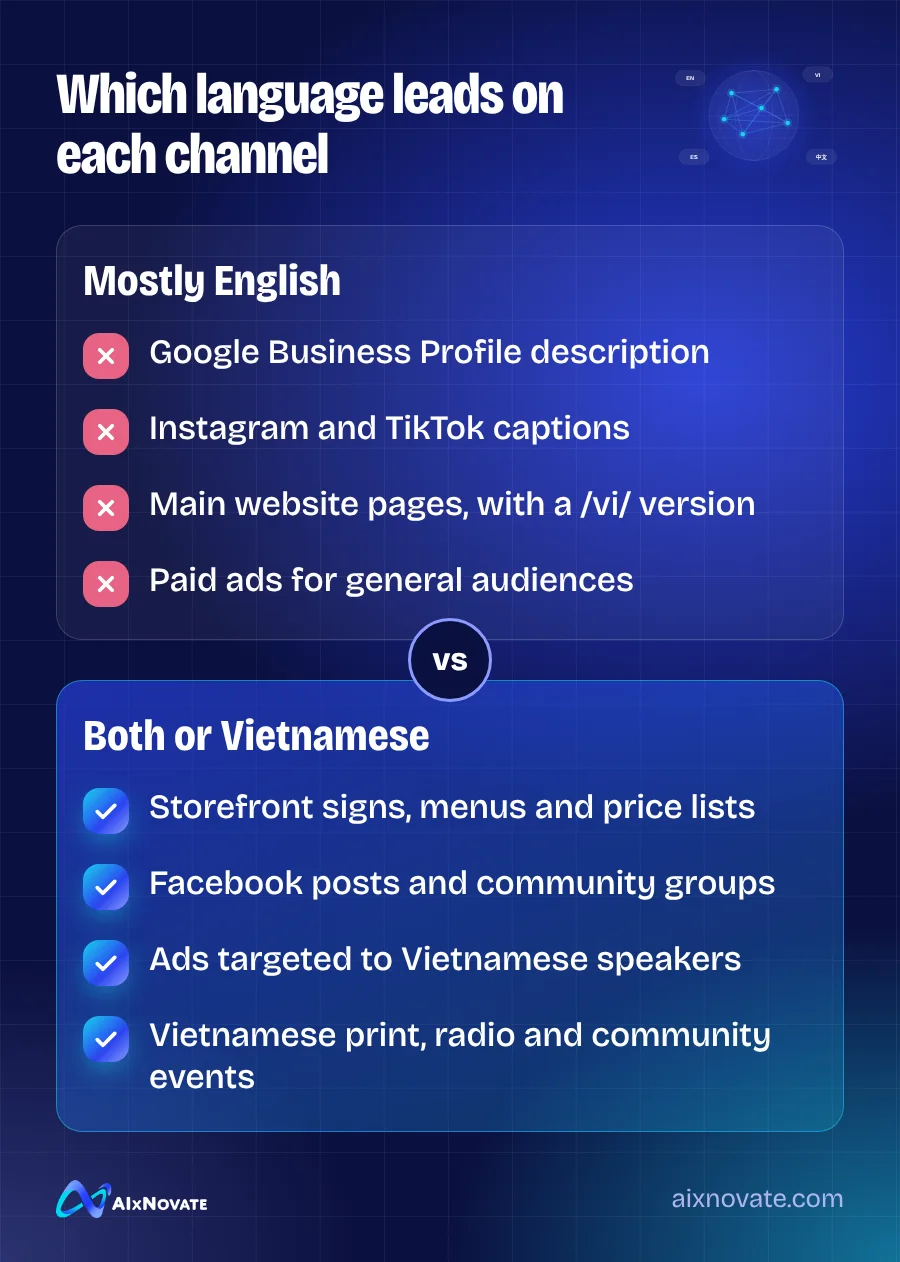
- Storefront signs and menus: Often both languages. Customers walking in should understand what you sell at a glance.
- Google Business Profile: Usually English for the description and services, with a line stating "We speak Vietnamese." Reply to reviews in the language they were written in.
- Website: Separate English and Vietnamese pages for your key content, with a clear language switch.
- Facebook: Frequently bilingual, since many Vietnamese-speaking customers and community groups are active there.
- Instagram and TikTok: Often English-led with Vietnamese phrases, depending on your audience.
- Print and community media: Vietnamese-language print, radio and community events can still reach customers who rarely search online.
Translate meaning, not just words
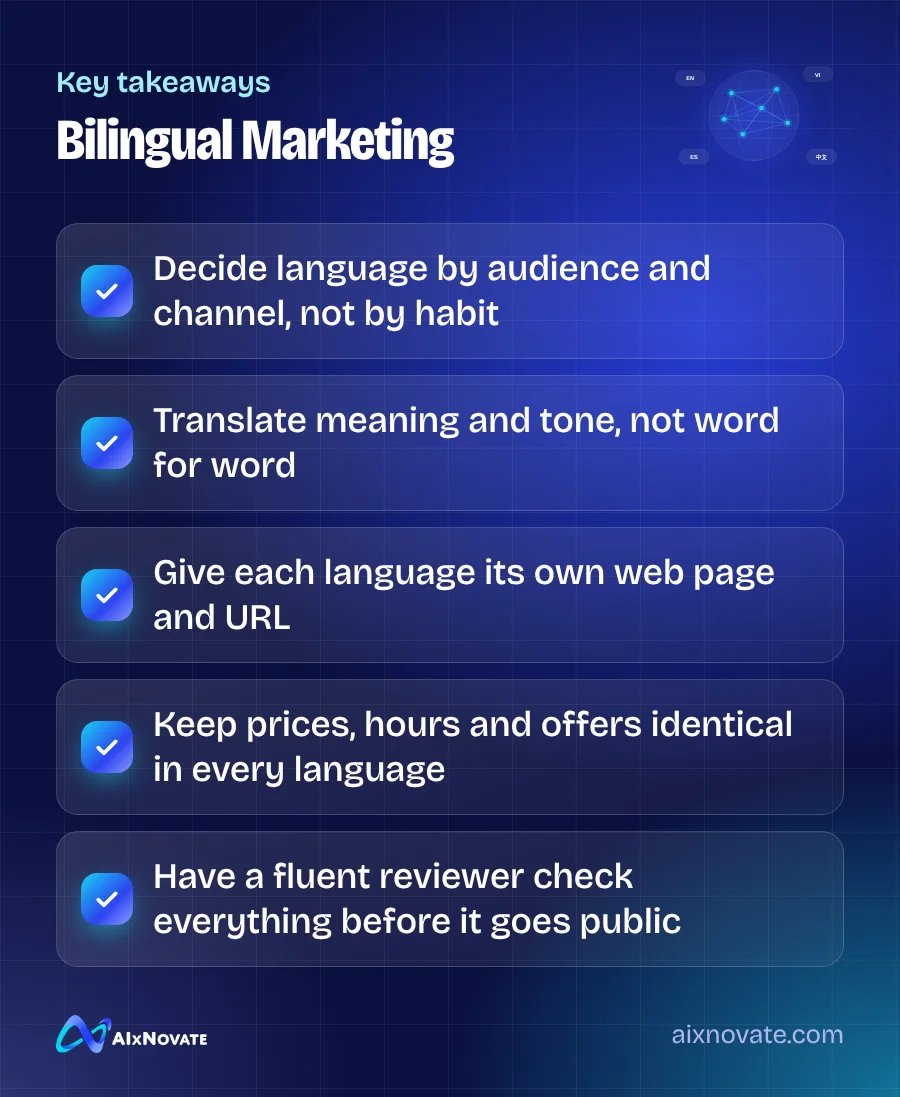
Literal translation is the most common bilingual marketing mistake. A slogan that sounds friendly in English may sound stiff, odd or even rude in Vietnamese, and the reverse is also true.
Practical rules for good translation
- Use a fluent human reviewer. Machine translation and AI tools are helpful for a first draft, but a native speaker should review anything customers will see.
- Match the right level of formality. Vietnamese uses different pronouns and forms of address depending on age and relationship. Decide how your brand addresses customers and keep it consistent.
- Check diacritics carefully. Missing or wrong tone marks change meanings. Make sure your fonts, printers and website display Vietnamese characters correctly.
- Keep names and product terms consistent. If a dish or service has a familiar Vietnamese name, use it, then explain it in English.
- Adapt examples and offers. A promotion tied to Tết may need a fuller explanation in English and none in Vietnamese.
AI translation has improved, and our article on multilingual AI and global communication explains how these tools work. They still make mistakes with tone and context, so treat them as assistants, not final authors. Our guide to translating marketing with AI explains when you still need a human.
Setting up a bilingual website
A bilingual site should help people and search engines find the right version. A few principles:
- Give each language its own URL, such as /vi/ for Vietnamese pages. Avoid switching text on the same URL with a script, which search engines may not see.
- Translate the pages that matter most first: homepage, main services, contact and booking.
- Add a visible language switcher at the top of every page, labeled in each language ("Tiếng Việt" and "English"), not with flags.
- Tell search engines how pages relate. Google's guide to localized versions of pages explains how hreflang tags connect translated pages.
- Keep details identical: prices, hours, phone numbers and policies must match exactly.
The same setup works for a third language. Our guide to Spanish-language marketing in Garden Grove and Santa Ana shows it applied to Spanish pages.
Bilingual social media and ads
On social media, you have three common options. Choose based on your audience and how much time you have.
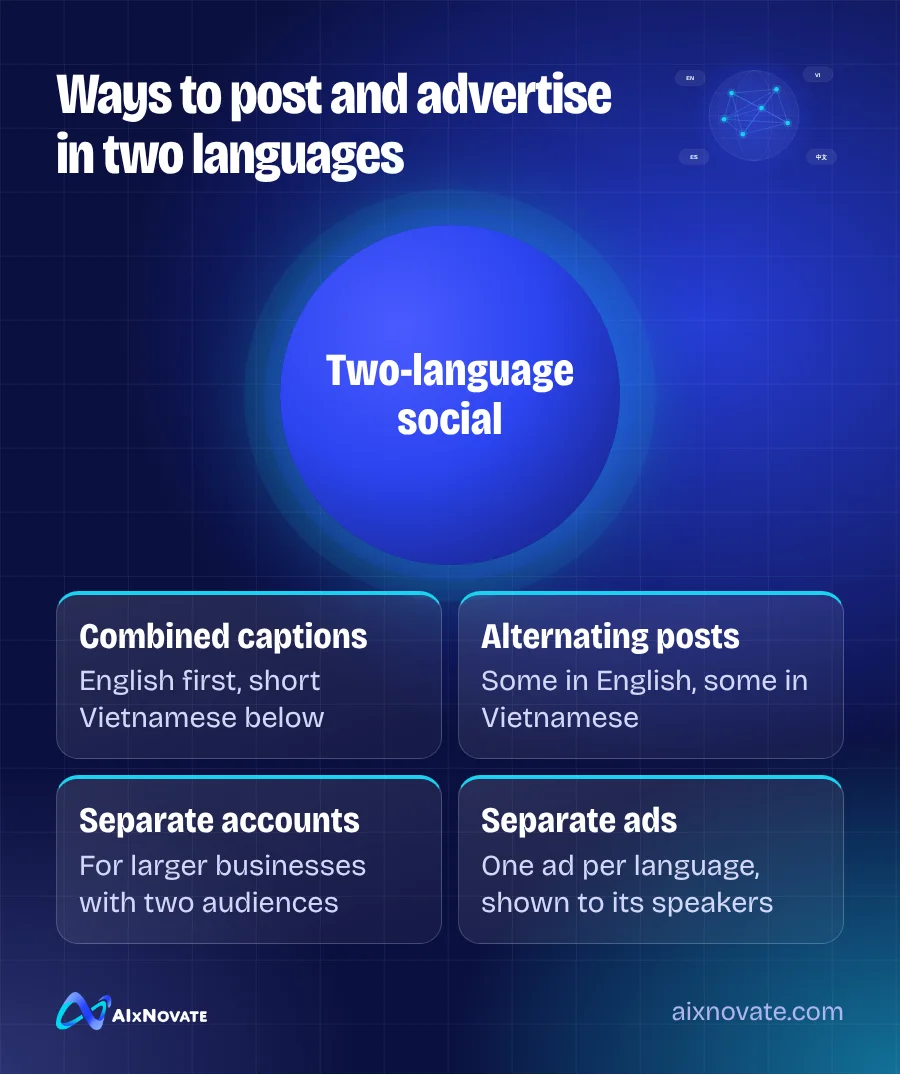
- Combined captions: English first, then a short Vietnamese version below. Easy to manage, reaches both groups.
- Alternating posts: Some posts in English, some in Vietnamese. Works if your followers are split.
- Separate accounts or ad sets: Makes sense for larger businesses with distinct audiences and the resources to manage both.
For paid ads, create separate versions for each language rather than cramming both into one ad. Platforms let you target by language preference and location, so you can show Vietnamese ads to Vietnamese speakers near your store and English ads to everyone else.
Signage, print and in-store materials
Bilingual marketing does not stop online. Menus, price lists, flyers, receipts and window signs all shape how customers see you. Keep a consistent design system across both languages: the same logo, colors and fonts, with the same layout so neither language looks like an afterthought. A small set of bilingual templates, the kind a graphic design project usually starts with, lets you update menus and flyers all year without redesigning each one.
Check one detail that often gets missed: when you update a price or policy, update it in both languages at the same time. Mismatched information is one of the fastest ways to lose trust.
Common bilingual marketing mistakes to avoid
- Translating only the ads. If the ad is in Vietnamese but the landing page, booking form and phone greeting are English-only, many customers will drop off.
- Letting one language fall behind. An old promotion still showing on the Vietnamese page while the English page has moved on looks careless.
- Using flags for languages. Flags represent countries, not languages, and can carry unintended meaning. Label languages by name instead.
- Skipping the review step. Even a short sign or caption deserves a second look from a fluent speaker before it goes public.
Frequently asked questions
Is it better to have one bilingual page or separate pages for each language?
For websites, separate pages for each language are usually better. Search engines can show the right version to the right searcher, and visitors get a clean reading experience. Mixed-language pages can work for a short menu or a flyer, but long mixed pages are hard to read and harder for search engines to understand.
Can I use AI tools to translate my marketing?
AI tools are useful for first drafts and for understanding customer messages. For anything public, such as website pages, ads, signs and offers, have a fluent speaker review the text. AI translation can miss tone, formality and cultural context, and it sometimes produces errors with Vietnamese diacritics or industry terms.
Do I need to translate my whole website?
No. Start with the pages that drive action: homepage, main services, contact, and booking or menu pages. Add more over time if Vietnamese-language visitors use them. A smaller set of well-translated pages is better than a full site translated poorly or left half-finished.
If you would like help planning marketing in more than one language, you can book a free 30-minute consultation; our team works in English, Vietnamese and Chinese, and multilingual campaigns are part of our digital and social media marketing work.