
Too busy to do marketing? A 2-hour-a-week marketing system for owners
No time for marketing? This 2-hour-a-week system splits the work into four short blocks so busy owners keep reviews, posts and follow-ups moving every week.

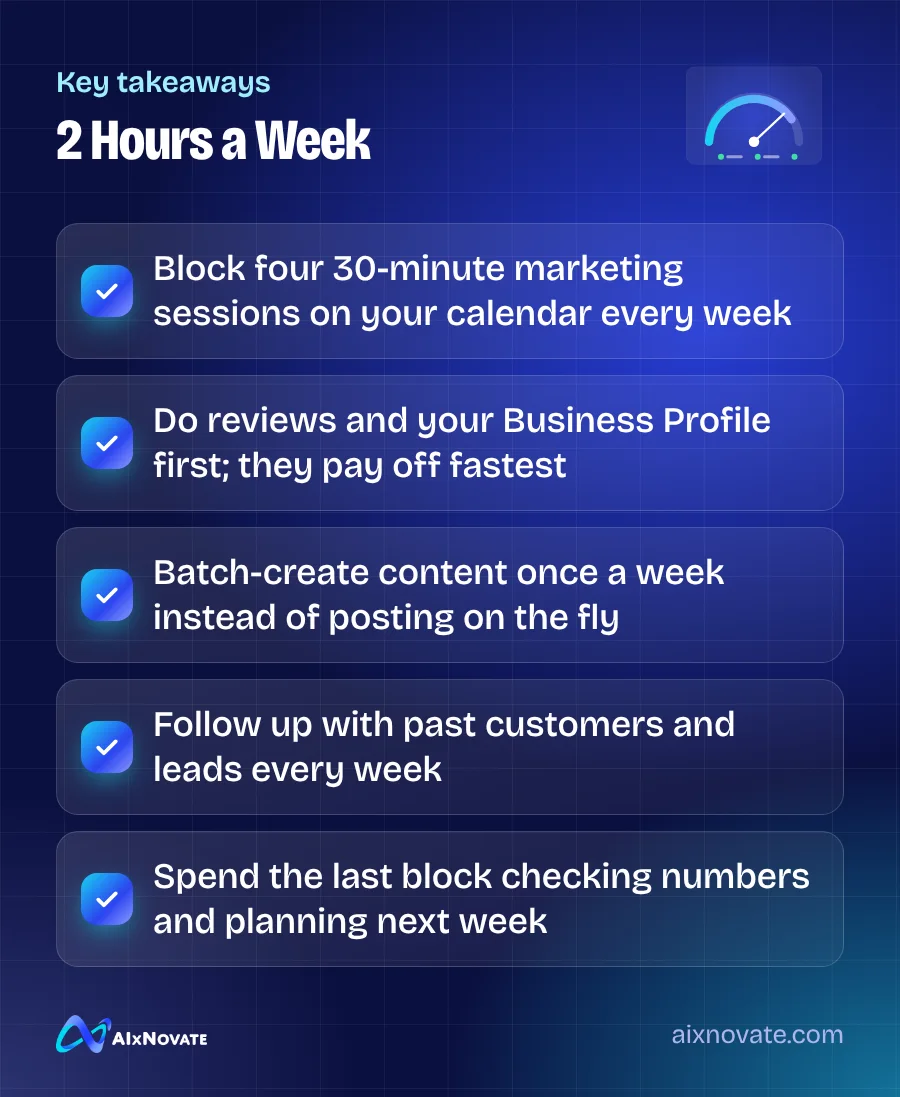
A workable marketing system for busy owners is four 30-minute blocks a week: one for reviews and your Google Business Profile, one for batching content, one for following up with leads and past customers, and one for checking numbers and planning next week. Two protected hours, done every week, usually beat ten hours in a burst once a quarter.
This guide is for owners who run the business and the marketing at the same time, and for whom "I'll post when things slow down" has turned into months of silence. The system works whether you do it yourself, share it with a staff member, or use it to direct outside help.
"I know I should market, but I have no time"
You open early, you close late, you cover shifts when someone calls in sick. Marketing keeps sliding to tomorrow. Then sales dip, you panic, and you try to do everything at once: a promotion, a burst of posts, maybe an ad. It works a little, things get busy again, and the cycle repeats.
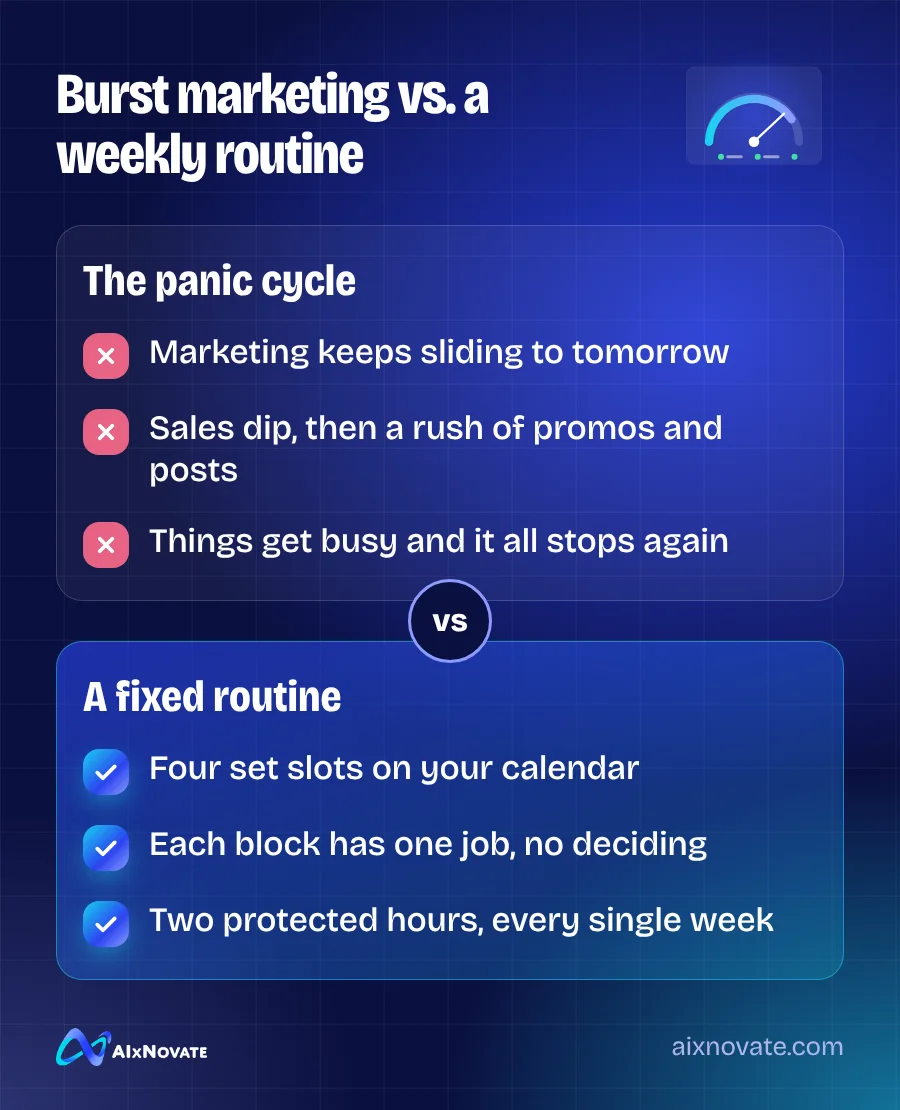
The problem is not discipline. It is that marketing has no fixed place in your week. A small, fixed routine solves that better than more motivation.
How the 2-hour marketing system works
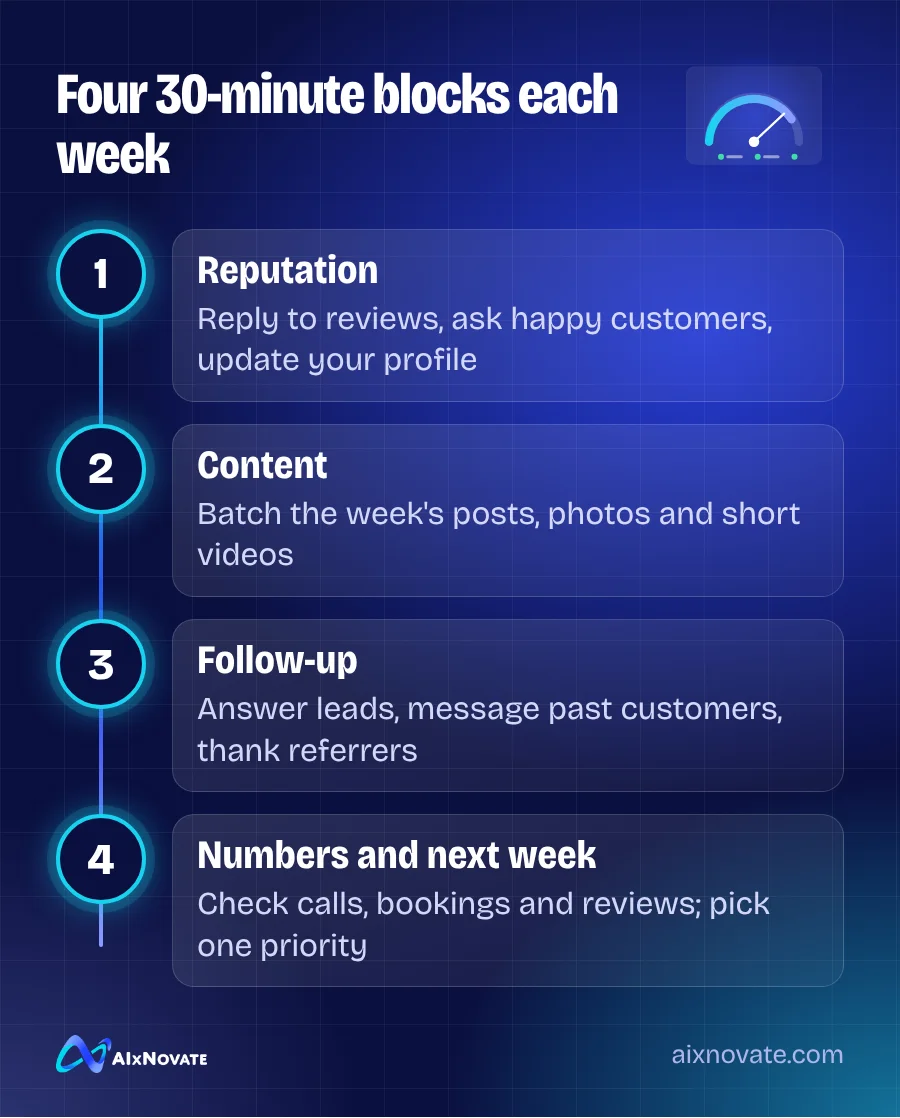
Pick four slots on your calendar, ideally at quieter times, such as an hour before opening or a slow mid-afternoon. Treat them like appointments. Each block has one job, so you never have to decide what to work on.
Block 1: reputation (30 minutes)
- Reply to every new review, positive or negative, briefly and politely.
- Send review requests to a few happy customers from the past week.
- Update your Google Business Profile: a new photo, a short update, any change in hours or services.
Google notes that complete, accurate information and responding to reviews can help your local presence; see its guide to improving your local ranking. AI tools can help you draft review replies faster, as covered in using AI to manage reviews and reputation.
Block 2: content (30 minutes)
- Pick this week's theme from your monthly plan.
- Take or gather photos and short clips from the week.
- Write and schedule three to five posts in one sitting.
Scheduling tools inside Meta let you plan posts for Facebook and Instagram in advance; the Meta Business Help Center explains how. For a faster way to fill the month, see how to plan a month of social posts with AI.
Block 3: follow-up (30 minutes)
- Check that every inquiry from the week got a response.
- Send a reminder or a seasonal message to past customers who agreed to hear from you.
- Thank anyone who referred a friend.
This block often brings the quickest return, because these people already know you.
Block 4: numbers and next week (30 minutes)
- Write down this week's calls, bookings, new reviews and website inquiries.
- Glance at Google Search Console once a month to see which searches bring visitors.
- Choose the one priority for next week.
A simple notebook or spreadsheet is enough. The point is to notice trends early instead of discovering a slow month after it has passed.
What a real week can look like
A restaurant owner in Garden Grove might run block 1 on Monday before lunch service, replying to weekend reviews while they are fresh. Block 2 happens Tuesday afternoon, filming two short clips of a new dish and scheduling the week's posts. Block 3 is Thursday morning, sending a message to past catering clients about upcoming holiday orders. Block 4 is Friday after closing, writing down the week's covers, calls and new reviews, and choosing next week's focus.
The exact days do not matter. What matters is that each block has a fixed home on the calendar and a single job.
Make the system stick
- Protect the time. If a block gets interrupted, move it within the same week; do not skip it.
- Use templates. Save review replies, follow-up messages and post formats you can reuse.
- Delegate parts. A front-desk staff member can take photos or send review requests. You keep the decisions.
- Connect it to a plan. The weekly blocks work best when they serve a yearly goal. Our guide to a simple 2027 marketing plan shows how to set one.
Adapting the system for Garden Grove and Orange County businesses
Local businesses in Orange County often serve customers in more than one language. Build that into the routine: write posts and follow-up templates in both languages once, then reuse them. Add local moments to your content block, such as Tết, the Strawberry Festival season or back-to-school, a few weeks ahead so you are not rushing.
If your shop is in a busy corridor like Garden Grove Boulevard or Brookhurst Street, photos of your storefront, parking and nearby landmarks help new customers find you and feel confident walking in.
When two hours is not enough
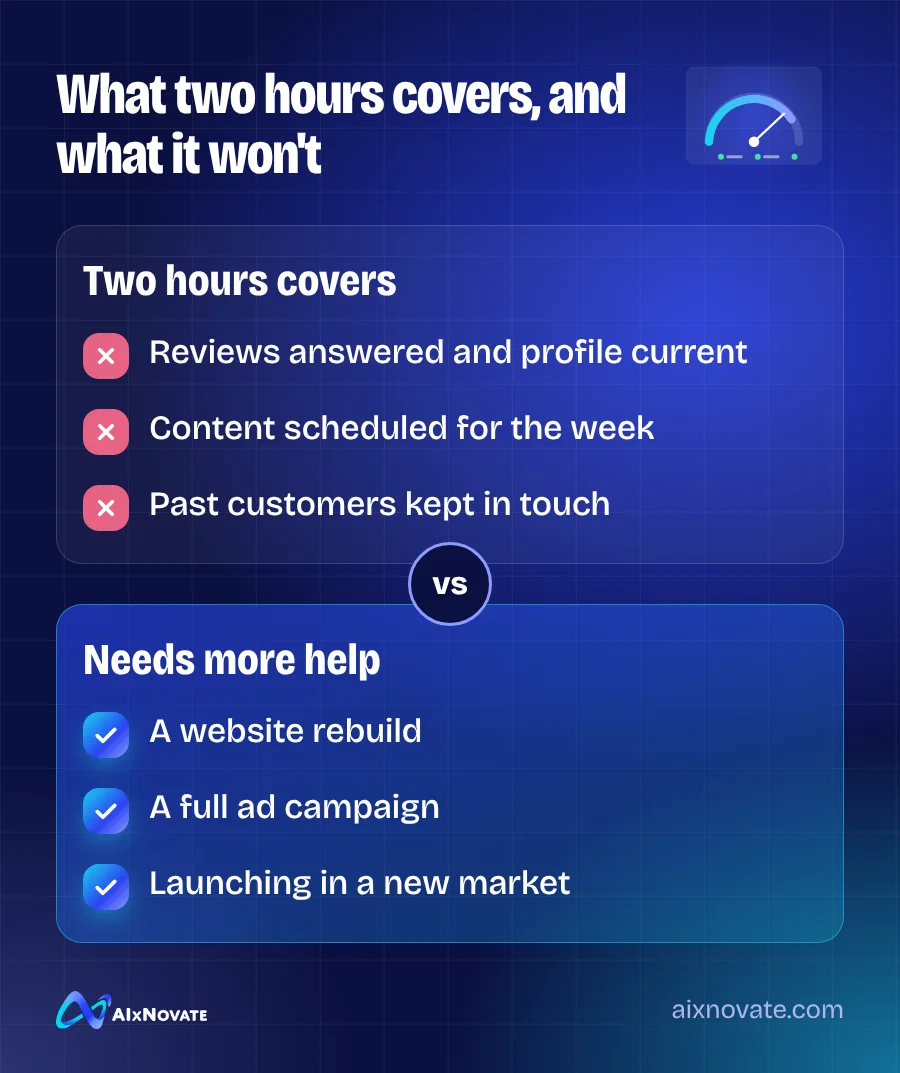
Two hours a week keeps the basics moving. It will not cover a website rebuild, a full ad campaign or a new market launch. If you find you are consistently skipping blocks, or the business needs more than maintenance, compare your options honestly. Our article on marketing employee vs. agency walks through the true cost of each so you can decide with your own numbers.
Even if you bring in help, keep the weekly blocks in some form. The owner's view of customers, offers and timing is hard to replace, and a short weekly check keeps any staff member or outside team pointed at what matters most to the business.
Frequently asked questions
Can two hours a week of marketing really make a difference?
For many local businesses, yes, because consistency matters more than intensity. Two focused hours each week keep reviews answered, your profile current, content scheduled and past customers engaged. That steady presence often outperforms occasional bursts of activity. It will not replace bigger projects like a new website or ad campaign, but it keeps the foundation strong.
What marketing should a busy owner do first?
Start with your Google Business Profile and reviews, because they influence local search and customer trust and take little time to maintain. Next, follow up with past customers who agreed to hear from you, since they already know you. Then add a weekly batch of social posts. Track calls and bookings so you can see what is working.
Should I hand this system to an employee?
You can share parts of it. Staff can take photos, send review requests and schedule posts using templates you approve. Keep the decisions yourself: the weekly priority, the offers and the replies to negative reviews. Proper training helps an employee do this well and saves you review time, so plan for it before you hand over the work.
If even two hours a week is too much, our Outsourced Marketing Team can run the whole system for you, with one account manager as your contact.
If you would like structured help, you can book a free consultation with AIxNovate or explore our marketing training programs for owners and staff.