
AI review management: reply faster and spot problems early
How to use AI for review management: draft replies faster, spot recurring complaints early, and stay within FTC and platform rules on reviews.

AI review management means using AI tools to draft review replies, summarize what customers praise and complain about, and flag urgent reviews quickly. It saves time and helps you spot problems early, but a person should personalize and approve every public reply, and AI must never be used to write or fake reviews.
This guide is for owners and managers of local businesses who get reviews on Google, Yelp, Facebook or industry sites and struggle to keep up. It covers a practical weekly routine, how to write replies that don't sound canned, and the rules you need to respect.
Why reviews matter for local businesses
Reviews influence both customers and search visibility. Google says local results are based mainly on relevance, distance and prominence, and that review count and ratings factor into local ranking; see its guide on how to improve your local ranking. Google also recommends responding to reviews.
Replies matter for a simple reason: future customers read them. A thoughtful response to a complaint often reassures readers more than a string of five-star ratings. For more on building a steady flow of reviews, see our guide to getting more Google reviews in Garden Grove.
Where AI review management helps
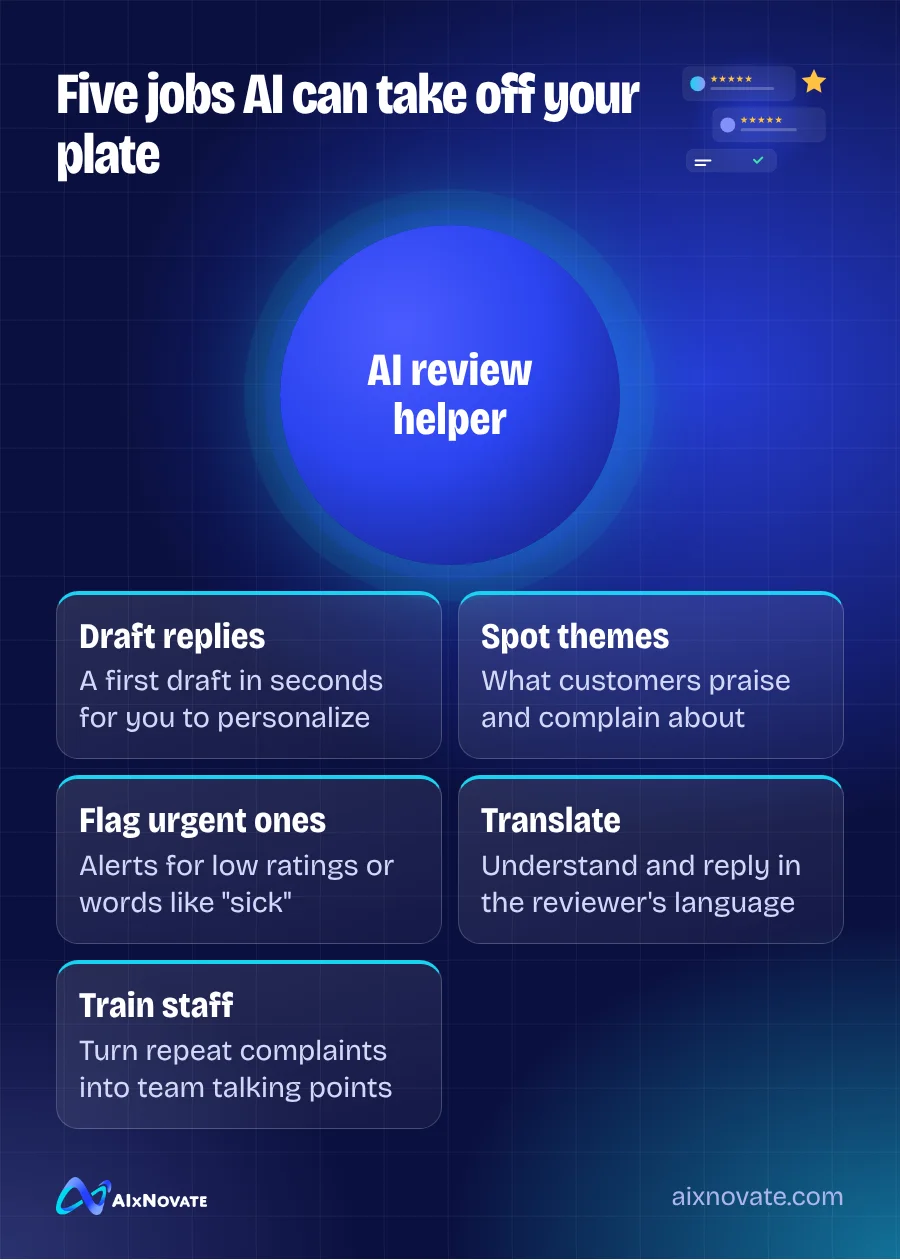
- Drafting replies. Paste in a review and your guidelines, get a draft in seconds, then personalize it.
- Summarizing themes. Once a month, paste in your recent reviews and ask: what do people praise most, what do they complain about, and what has changed since last month?
- Flagging urgency. Many review tools and some AI features can alert you to low ratings or words like "sick," "refund" or "rude" so you respond quickly.
- Translating. Understanding reviews written in Vietnamese, Spanish, Korean or Chinese, and drafting a reply in the same language for a fluent staff member to check.
- Training staff. Turning recurring complaints into short team discussion points.
Where it goes wrong
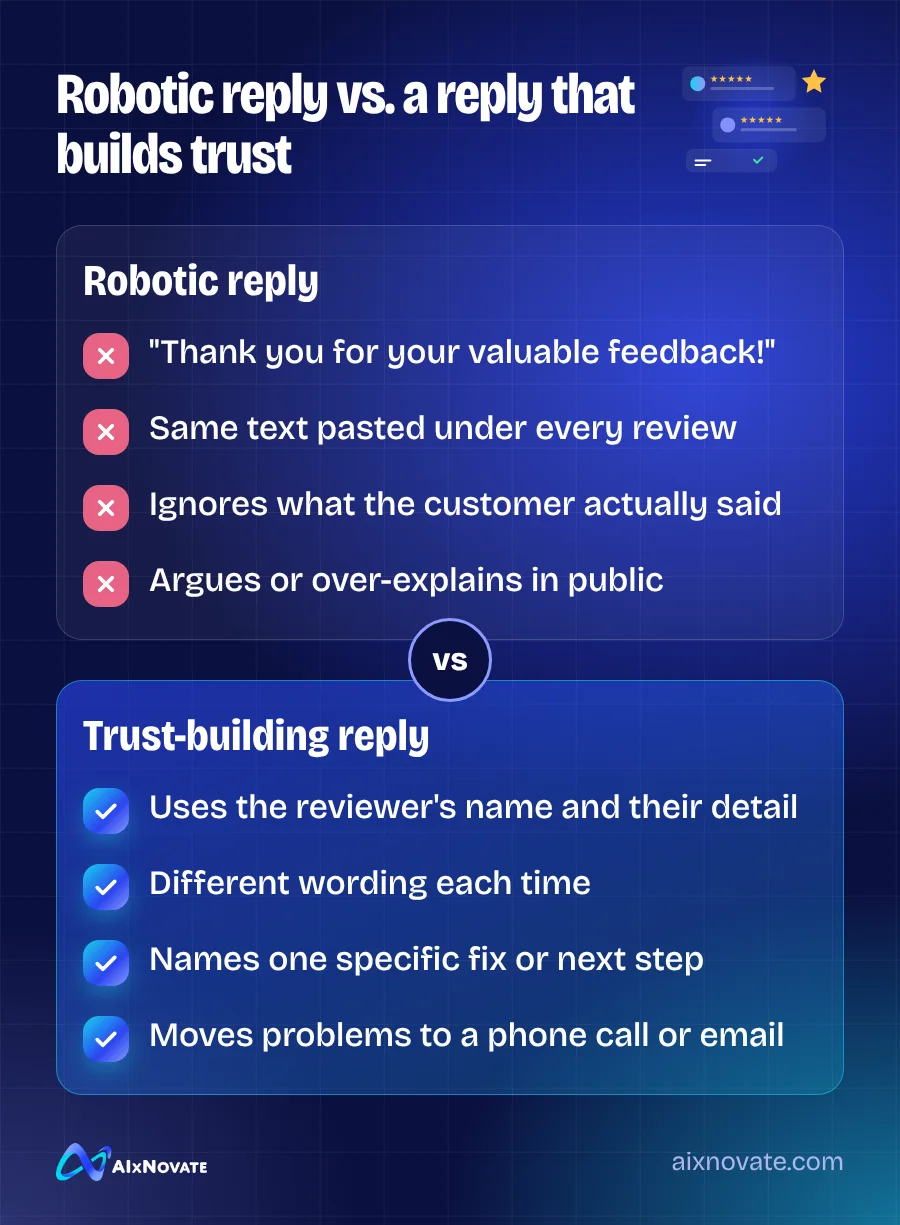
Canned replies
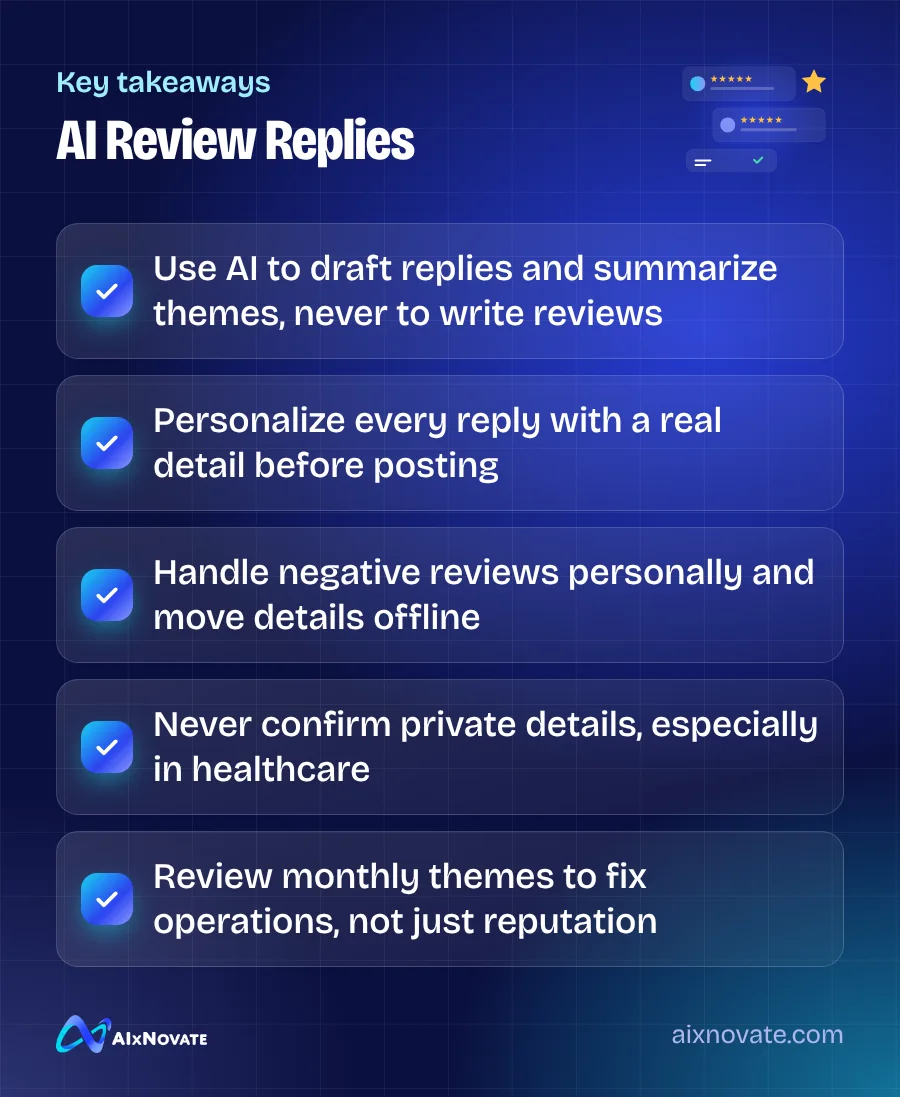
The fastest way to make customers distrust your replies is to paste the same AI-polished sentence under every review. Readers notice. Each reply should mention something the reviewer actually said.
Fake or incentivized reviews
Never use AI to write reviews about your own business, a competitor, or on behalf of customers. The FTC has made clear that fake reviews and testimonials are deceptive, and it has rules on buying reviews and on suppressing negative ones. Read the FTC's guidance on endorsements, influencers and reviews. Platforms set their own rules too; Yelp for Business, for example, has guidance on what businesses should and should not do about reviews. This is general information, not legal advice.
Privacy mistakes
A public reply should never reveal details the customer did not share. In healthcare, including med spas, dental and medical offices, even confirming that someone is a patient can raise privacy concerns. Keep replies general, and follow your compliance advisor's guidance. Also avoid pasting customers' private information into AI tools.
A weekly AI review routine
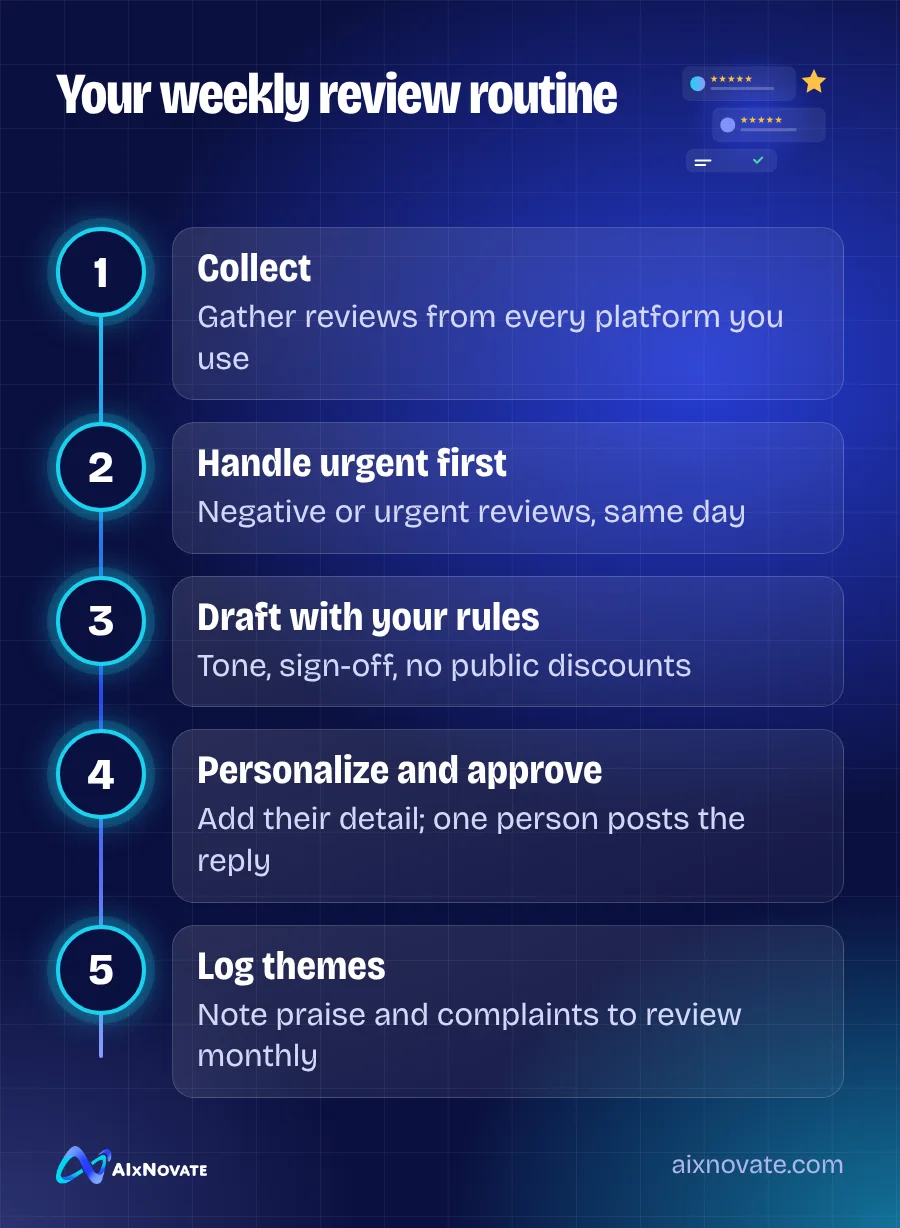
- Collect. Check all platforms where you get reviews, or use a tool that gathers them in one place.
- Triage. Handle anything negative or urgent first, ideally the same day.
- Draft with guidelines. Give the AI your reply rules: tone, sign-off, no discounts in public, no admissions of fault without manager review, invite unhappy customers to call or email.
- Personalize. Add the reviewer's detail, the staff member's name if appropriate, and your own wording.
- Approve and post. One person owns the final reply.
- Log themes. Keep a short running list of praise and complaints to review monthly.
A prompt that works well for drafting:
Draft a reply to this Google review for our nail salon in Garden Grove. Tone: warm, brief, sincere. Mention the specific thing they liked. Do not offer discounts. Under 60 words. Give two versions with different wording. Review: [paste].
Turn review themes into fixes
The most valuable part of AI review management is often not the replies but the monthly summary. When you paste in a month of reviews and ask what keeps coming up, patterns appear that are easy to miss one review at a time: wait times on Saturday mornings, a phone line that goes unanswered at lunch, a dish that arrives lukewarm for delivery, confusion about parking.
Pick one theme each month and fix it in the business itself. Then watch whether that complaint fades in the following months. That habit improves your rating more reliably than any reply template, because it removes the reason for the bad reviews.
Handling negative reviews with AI's help
AI is useful for calming your first draft. Owners understandably feel defensive when a review seems unfair. Write your honest reaction, then ask AI to turn it into a calm, professional reply that acknowledges the experience, avoids arguing and invites the customer to continue the conversation privately.
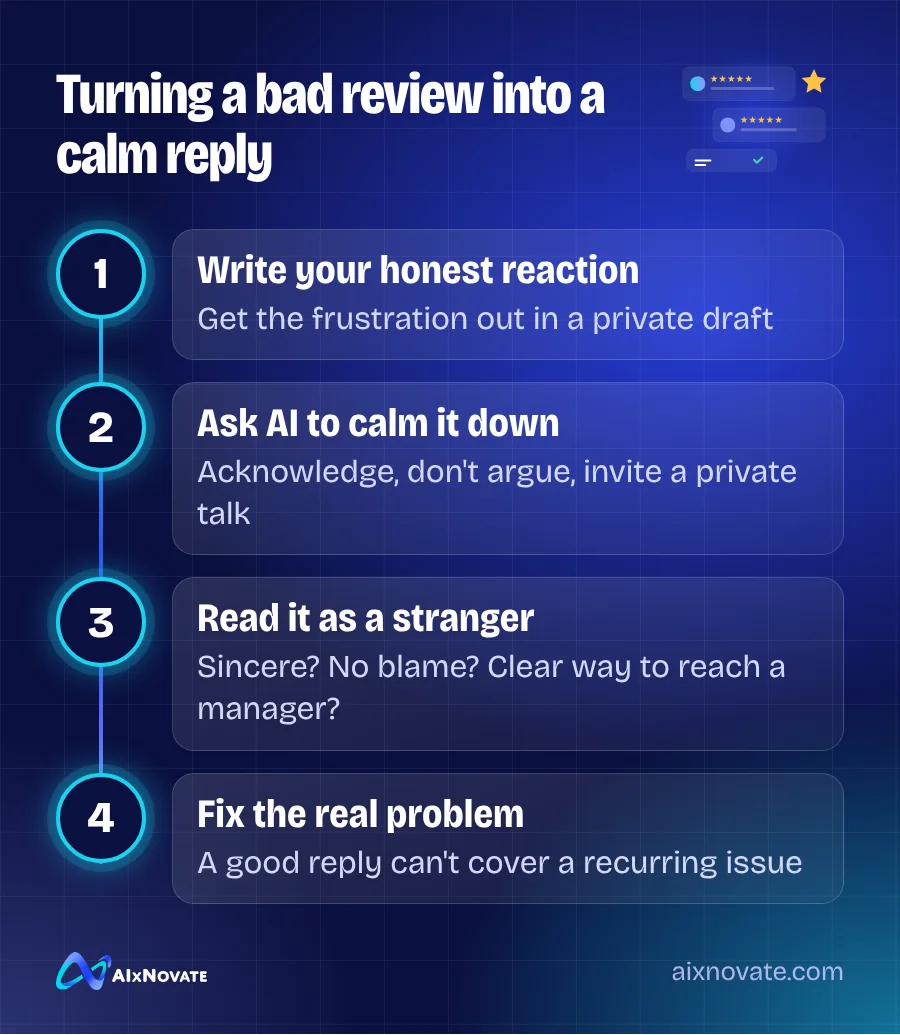
Then read it as a stranger would. Does it sound sincere? Does it avoid blaming the customer? Does it give a clear way to reach a manager? If the review raises a real problem, fix the problem; a good reply cannot cover a recurring issue for long.
Fast, accurate answers also prevent some negative reviews in the first place. A well-configured website assistant can resolve simple questions before they become frustrations; see our guide to AI chatbots for local businesses.
Reviews in Garden Grove and Orange County
Orange County customers review in many languages. A Vietnamese review deserves a Vietnamese reply, reviewed by a fluent staff member, and the same goes for Spanish, Korean and Chinese. Replying in the reviewer's language shows respect and tells other readers in that community that they will be understood.
Your review profile also works together with your listing. Keep your Google Business Profile accurate so reviews are attached to correct hours, services and photos. Review signals are one part of local visibility, which is why we treat review workflows as part of our local SEO work rather than a separate task.
Frequently asked questions
Is it okay to use AI to reply to reviews?
Yes, as a drafting tool. Many businesses use AI to write a first draft, then personalize and approve it before posting. Problems arise when replies are posted unedited, sound identical, or include incorrect details. Keep a human in charge of every public reply, and never use AI to write the reviews themselves.
Should I reply to every review?
Replying to most reviews, positive and negative, is a good habit and something Google recommends. Prioritize negative and detailed reviews first. Short positive reviews can get brief, personal thanks. Consistency matters more than length: customers reading your profile want to see that someone is listening.
Can I ask AI to detect fake reviews about my business?
AI can help you notice patterns, such as many similar reviews in a short time or reviewers with no history, but it cannot prove a review is fake. If you believe a review violates a platform's policy, use that platform's official reporting process and provide factual details. Avoid public accusations in your reply.
Want a review routine set up for you? It is included in our Google Business Profile Optimization packages.
If you want help setting up a review routine and reply guidelines for your team, book a free 30-minute consultation, or see how our SEO and local search service handles reputation.